

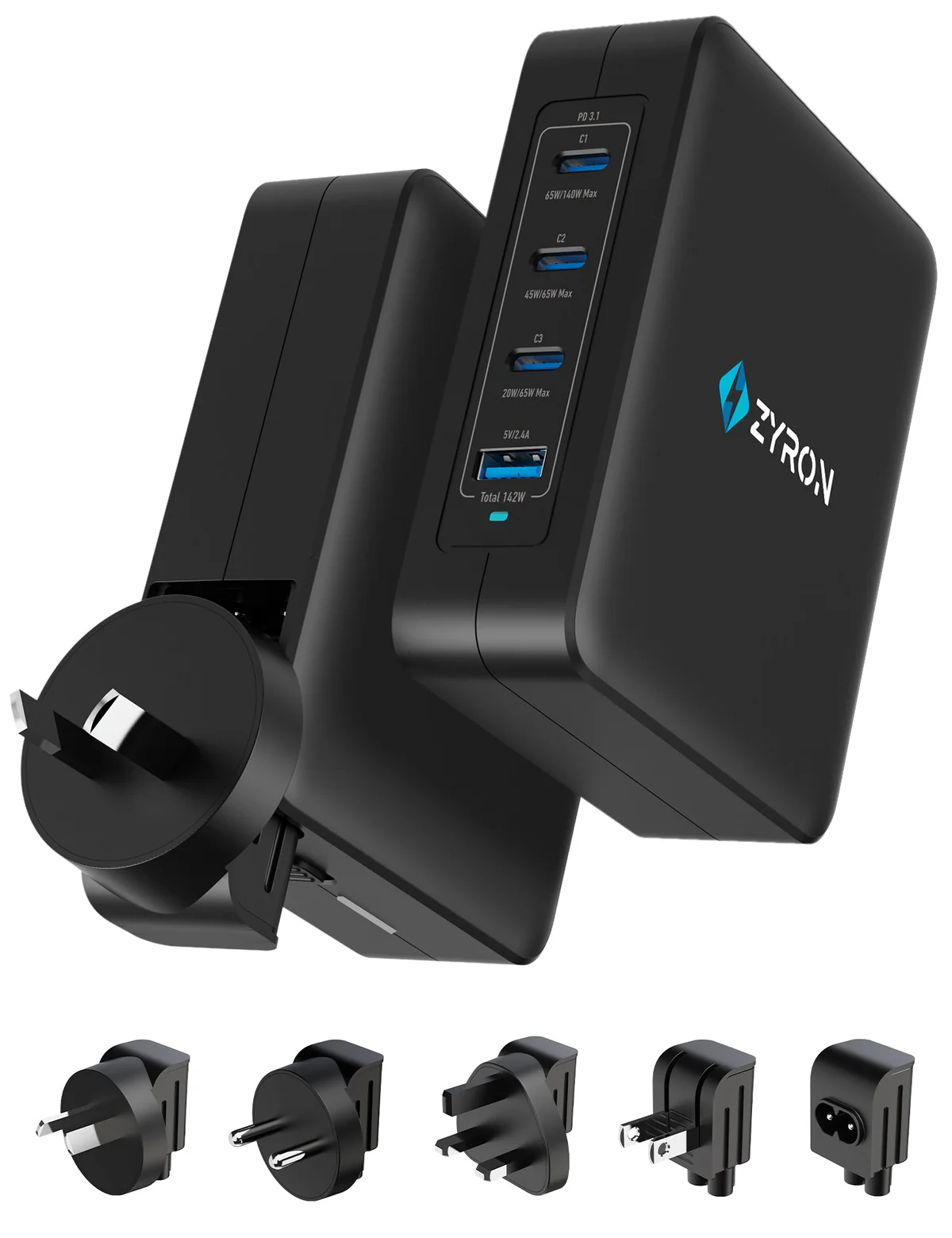

If you’ve bought a new phone, laptop or tablet recently, you’ve probably noticed that chargers have changed. They’re smaller, run cooler, and often carry wattage numbers that would have seemed implausible a few years ago from something the size of a matchbox. The reason for this shift is a technology called GaN — Gallium Nitride — and once you understand what it does, it’s hard to go back to a traditional charger.
The Problem With Traditional Chargers
Standard wall chargers use silicon-based transistors to convert mains power (240V AC in Australia) to the lower DC voltage your devices need. Silicon works, but it’s not particularly efficient — it generates a lot of heat in the process, which is why older chargers get warm to the touch. To manage that heat and prevent damage, manufacturers have to build in extra bulk: larger housings, heavier components, and more plastic to act as insulation.
The result is the classic oversized brick charger that barely fits in a travel bag, blocks the adjacent power point, and takes up disproportionate space for what it actually does.
What GaN Does Differently
Gallium Nitride is a semiconductor material that conducts electricity far more efficiently than silicon. It has a wider bandgap — a technical property that essentially means it can handle higher voltages and switch power on and off faster, all while generating significantly less heat.
Less heat means less thermal management is needed, which means the charger can be built much smaller without risk of overheating. The same 65W or 100W output that used to require a chunky brick can now fit in a charger not much larger than a standard phone plug.
The key advantages for everyday users:
Smaller and lighter. A 65W GaN charger typically weighs around 100g and is roughly the size of a large die. The silicon equivalent at the same wattage is two to three times the size.
Runs cooler. Better efficiency means less wasted energy as heat. GaN chargers are noticeably cooler during use, which is better for both longevity and the surface you rest them on.
Faster charging. GaN chargers support USB Power Delivery (USB-PD), the protocol that enables high-wattage fast charging. This means they can charge a MacBook, iPad, and iPhone simultaneously through multiple ports without sacrificing speed.
One charger for everything. A quality multi-port GaN charger can replace the separate chargers for your laptop, phone, and tablet. For anyone working remotely or travelling regularly, that’s a meaningful reduction in cables and adapters.
GaN Chargers in Australia
The Australian market has caught up quickly. GaN technology is now widely available across multiple output tiers — from compact 30W single-port options suitable for phones to 100W+ multi-port units that can run a full laptop setup.
For most Australians, the 65W tier is the practical sweet spot. It charges any modern smartphone at full speed, covers most ultrabooks and the MacBook Air, and is still compact enough to drop in a shirt pocket. A good compact GaN charger at this wattage genuinely replaces every other charger in your bag.
If you regularly charge a MacBook Pro, high-performance Windows laptop, or multiple devices at the same time, stepping up to 100W gives you the headroom to run everything flat-out through a single wall point.
Is GaN Worth the Price Premium?
Compared to cheap silicon chargers, yes — substantially. The efficiency gains, smaller size, cooler operation and multi-device capability make GaN chargers a genuine upgrade rather than a marginal one. The price gap has also closed considerably over the past two years as GaN technology has become mainstream.
When comparing options, look for certified chargers from brands with local Australian warranty support. The charging standards market has a counterfeit problem — cheap chargers that claim GaN technology but use substandard components are a real safety risk.
You can browse the full range of GaN charger Australia options from Zyron Tech, an Australian accessories brand that covers everything from compact single-port travel chargers through to high-output desktop multi-port units — all with local support and genuine spec transparency.
The Takeaway
GaN isn’t a marketing buzzword — it’s a genuine materials science advancement that makes chargers meaningfully smaller, cooler and more capable. If you’re still using the brick that came in the box with a laptop from 2019, upgrading to a modern GaN charger is one of the most practical tech improvements you can make this year. For Australians specifically, where 240V mains power means older chargers already run warm, the efficiency benefits are even more pronounced.
The technology has matured. The prices have come down. There’s not much reason to stick with silicon anymore.