
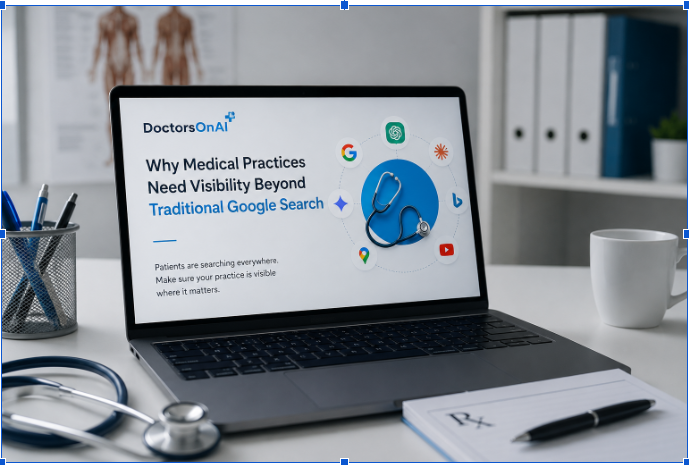

Patients no longer discover doctors through one predictable route. A person may still type “dermatologist near me” into Google, but another may ask ChatGPT which type of specialist treats a recurring skin problem, search Google Maps for highly rated clinics, compare doctors on a healthcare platform, or ask an AI assistant to explain which local provider appears experienced with a particular procedure.
That change creates a new problem for medical practices: ranking well on a conventional search-results page is valuable, but it no longer represents the whole discovery journey.
doctorsonai.com approaches this problem as a medical marketing platform focused on helping doctors and practices become visible across traditional search, local search, AI-generated answers, reputation channels, websites, content, and paid acquisition. The company describes its service mix as covering SEO, AEO, GEO, LLM-oriented search visibility, Google Business Profile optimization, advertising, reputation management, branding, and website development.
What DoctorsOnAI Actually Is
The name can initially sound like a healthcare artificial-intelligence product, so the distinction matters.
DoctorsOnAI is not an AI doctor, diagnostic system, telemedicine provider, or clinical decision-making service. Its published terms explicitly state that the company is a marketing agency and does not provide medical advice or clinical services.
Instead, its focus is the business side of medical visibility: helping actual physicians, clinics, specialists, and healthcare practices get discovered by prospective patients.
That makes doctorsonai part of a newer category of medical marketing businesses. Traditional healthcare SEO agencies have generally concentrated on Google rankings, local maps visibility, content, backlinks, and conversion-focused websites. The newer challenge is broader: practices increasingly need information about them to be understandable not only to search engines but also to AI systems that summarize, compare, and recommend information.
This does not make traditional SEO obsolete. It makes SEO one layer of a larger discovery system.
Why AI Search Changes Medical Marketing
A conventional search engine usually gives the user choices. It might display a local map pack, hospital pages, physician profiles, directories, articles, advertisements, and organic results.
Generative AI often works differently.
Someone might ask:
- “Who is a good orthopedic specialist for knee replacement in my area?”
- “What kind of doctor should I see for chronic sinus problems?”
- “Find a pediatric dentist near me with strong patient reviews.”
- “Compare these three fertility clinics.”
- “Which cardiologists in this city specialize in preventive cardiology?”
An AI system may synthesize information before the user ever visits a practice website.
That changes what medical visibility means. A practice needs enough clear, consistent and trustworthy information across the web for search and AI systems to understand basic facts such as who the doctor is, where the clinic operates, what specialties are offered, which conditions or procedures are relevant, and why the source appears credible.
The goal is not to “trick” an AI model into recommending a doctor. Sustainable visibility comes from making verifiable information easier to find, interpret and connect.
SEO, AEO, GEO and LLM Visibility Are Related but Not Identical
These terms are frequently bundled together, sometimes without much explanation.
SEO, or search engine optimization, is still the foundation. It improves the ability of search engines to crawl, understand and rank webpages for relevant searches.
AEO, or answer engine optimization, focuses more heavily on creating information that can answer specific questions clearly. A page explaining who is suitable for LASIK surgery, for example, should give a direct, medically responsible answer rather than surrounding the answer with several hundred words of promotional copy.
GEO, commonly called generative engine optimization, considers how information may be interpreted and surfaced by generative search products.
LLM visibility goes slightly wider. Large language models can encounter information about an organization through websites, third-party references, structured information, reputable publications and other accessible sources. Consistency and entity clarity therefore become valuable.
Doctors On AI positions these disciplines together rather than treating AI discovery as an isolated marketing trick. Its website describes a broader system covering organic search, AI search, local visibility, paid advertising, reputation, content and branding.
A Doctor’s Website Has to Do More Than Rank
A medical website used to be judged heavily by a few obvious questions: Does it rank? Does it load quickly? Does it generate calls?
Those questions still matter, but a strong medical website now has another responsibility: it should function as a reliable source of structured information about the practice.
A useful specialist page, for example, should make several things unambiguous:
- the physician’s name and professional role;
- specialty and areas of practice;
- clinic location;
- services and procedures genuinely offered;
- relevant qualifications that can be verified;
- appointment or contact options;
- medically reviewed educational information where appropriate.
Vague pages make this harder. A page containing 1,500 words about “world-class care” but little specific information may sound promotional while giving search systems surprisingly little to work with.
Clear information is generally more valuable than inflated copy.
Local Search Still Carries Enormous Weight
AI search receives much of the attention, but medical care is fundamentally local for many specialties. A patient looking for an ENT doctor, dentist, physiotherapist, pediatrician or dermatologist generally needs someone within a practical travel distance.
That makes local search infrastructure essential.
Google Business Profile information, consistent practice details, relevant categories, location pages, patient reviews and accurate contact information can all support the discovery process.
The important shift is that these signals should not be treated as separate marketing projects.
Imagine a physician whose website describes one clinic address while directories show an old location and another profile uses a different practice name. A human visitor may become confused. A search engine or AI system attempting to establish the identity of the practice faces the same problem.
Entity consistency is therefore both a marketing issue and an information-quality issue.
Reputation Becomes Part of Search Visibility
Reviews have always influenced patient decisions, but their role becomes even more interesting when search systems summarize information.
A patient might no longer manually read 40 reviews. Instead, an AI-powered interface could eventually help summarize recurring themes across accessible sources. That makes the underlying reputation footprint increasingly important.
The sensible response is not aggressive review manipulation. It is a repeatable reputation process: make it easy for legitimate patients to leave feedback where permitted, monitor profiles, respond professionally, correct inaccurate business information, and avoid incentives or practices that violate platform or healthcare advertising rules.
DoctorsOnAI’s published content already treats online reputation as a distinct part of medical practice marketing rather than an afterthought.
Medical Marketing Has a Higher Trust Requirement
Marketing a doctor is not the same as marketing a pair of shoes.
Claims about outcomes, treatments, qualifications and patient experiences can carry serious consequences. Advertising rules also differ between countries and sometimes between professional bodies or jurisdictions.
DoctorsOnAI appears to recognize that geographic distinction in its country-specific material. For example, its Germany-focused service page references the country’s Heilmittelwerbegesetz framework when discussing medical marketing and search visibility.
That is the right general principle even outside Germany: healthcare marketing needs local compliance awareness.
A campaign that is acceptable in one country cannot automatically be copied into another.
The same restraint should apply to AI optimization. Generative search visibility should never depend on fabricating doctor credentials, publishing invented reviews, overstating treatment outcomes, creating fake citations, or manufacturing supposed medical authority.
What a Strong AI-Era Medical Visibility Strategy Looks Like
For most practices, the best approach is layered rather than channel-specific.
First, establish a technically sound website that clearly identifies the practice and its services. Then build useful specialty, treatment and location content around genuine patient information needs.
Strengthen local business information and reputation signals. Earn legitimate mentions and links where appropriate. Keep physician information consistent across major profiles. Publish medically responsible educational content instead of mass-producing lightly differentiated pages.
Finally, evaluate how the practice appears in newer discovery environments. Search for the questions real patients might ask an AI assistant rather than checking only the practice name.
For example, a cardiologist should care about more than whether the website ranks for the doctor’s name. The harder question is whether credible online information connects that physician to the relevant specialty, location, services and expertise when a patient asks a broader question.
That is where modern search strategy becomes interesting.
The Biggest Mistake Is Treating AI Visibility as a Shortcut
There will inevitably be services promising guaranteed ChatGPT rankings or instant inclusion in AI recommendations. Those claims deserve skepticism.
Generative systems differ, their retrieval methods change, and the exact sources used for individual answers can vary. No responsible agency can control every answer produced by every AI platform.
What can be improved is the information environment surrounding a medical practice.
A clinic can make its website clearer. It can strengthen technical SEO. It can publish better answers. It can build stronger third-party authority. It can improve local profiles, remove contradictory information and develop a real reputation footprint.
Those are durable assets regardless of which search interface becomes dominant.
Where DoctorsOnAI Fits
DoctorsOnAI represents a broader change happening inside digital marketing: the boundaries between SEO, reputation management, branding, local optimization and AI discovery are becoming less useful from the client’s perspective.
A physician does not ultimately need “ten units of SEO” and “five units of GEO.” The physician needs appropriate patients to discover the practice, understand what it offers, trust the information they encounter and have a clear path to making contact.
DoctorsOnAI says it operates as part of Techno Hiker Pvt Ltd and focuses specifically on bringing this broader search approach to medical practices. Its public company information also connects the project with experience in SEO and link building rather than presenting it as a clinical AI business.
That distinction is important.
AI is changing how people retrieve information, but the fundamentals of trustworthy medical marketing remain surprisingly familiar: accurate information, genuine authority, strong reputation, useful content, technical accessibility and a clear patient experience.
The interface through which patients discover a doctor may keep changing. Building a medical presence that deserves to be discovered is the part that lasts.