

Oracle-related losses hit $14.6 million in H1 2025 alone. That figure only captures traceable events. The silent, untracked losses from data drift do not show up in incident reports at all.
The tokenized real-world asset market exceeded $23 billion by mid-2025, growing over 260% in six months. Analysts at Boston Consulting Group project the sector could reach $16 trillion by 2030. Citi estimates $4 to $5 trillion in tokenized securities alone.
Behind this growth sits a structural vulnerability that most project teams, investors, and auditors consistently miss: data drift. Not oracle manipulation. Not smart contract bugs. The quiet, compounding gap between what the blockchain believes an asset is worth and what that asset is actually worth in the physical world.
This article breaks down exactly what data drift is, why it is uniquely dangerous for real-world assets, how arbitrage bots exploit it, and what the latest oracle infrastructure in 2026 is doing to fight back.
What Is Data Drift in Real-World Asset Oracles?
Defining Data Drift in Blockchain Systems
Most oracle risk discussions focus on two problems: stale data and manipulation. Data drift is a third, distinct category that combines elements of both but behaves differently.
Stale data is a one-time missed update. A price feed fails to refresh for 15 minutes, then resumes. The problem is temporary.
Data drift is cumulative and structural. It is the compounding divergence that builds between an asset’s on-chain oracle value and its actual real-world value when the oracle update frequency is systematically slower than the pace of real-world change. No single update fails. The system keeps reporting, but it keeps reporting a reality that has already moved.
Blockchain immutability makes this worse, not better. Once a drifted value triggers a smart contract, that execution cannot be undone. A liquidation that fires on stale collateral data is permanent. The oracle correcting itself three hours later does not reverse the transaction.
The other critical feature of data drift is silence. No error is thrown. No alarm sounds. The protocol operates completely normally on data that no longer reflects reality.
How RWA Oracles Connect Physical Assets to Smart Contracts
Before understanding drift, it helps to understand the pipeline that creates it. Every tokenized real-world asset relies on a four-stage data journey from the physical world to the blockchain.
Stage 1: Data Collection. Physical data is sourced from government databases, commodity reporting agencies, property registries, appraisal firms, or IoT sensor networks. The data exists somewhere in the real world in some form.
Stage 2: Verification. The collected data is cross-referenced against multiple sources to confirm authenticity. This step is necessary for trust, but adds time.
Stage 3: Aggregation. Multiple data points are weighted and combined to produce a single feed value. For financial assets, this happens in milliseconds. For physical assets, it can take days.
Stage 4: On-Chain Publication. The aggregated value is published to the blockchain. At this moment, reality is frozen into a number that all smart contracts will trust until the next update.
Each stage introduces its own latency. Drift can originate at any stage. And errors compound as they move downstream.
Why Traditional Oracle Security Audits Miss This Risk
Oracle security audits are designed to catch the wrong type of problem. They test for manipulation attacks: price oracle exploits, flash loan-driven price distortion, and centralized node compromise.
What they do not test is environmental change. What happens when the real world changes faster than the reporting cycle? What happens when a government agency’s reporting schedule is slower than a market-moving event?
Regulatory reporting delays, geographic data fragmentation, and non-continuous physical data sources fall outside every standard audit framework. A protocol can pass every published security audit and still be operating on systematically drifted data. The audit certified that nobody manipulated the oracle. It said nothing about whether the oracle was telling the truth about the current state of a field in Iowa or an apartment block in Warsaw.
The Unique Challenge of Real-World Assets
Why RWAs Depend More Heavily on Accurate Off-Chain Data
For crypto-native assets like ETH or BTC, price discovery happens continuously, across thousands of liquid venues, 24 hours a day. The oracle aggregates data that is being generated constantly by markets.
For real-world assets, no such continuous price discovery exists. The oracle is the price. There is no competing on-chain mechanism checking the oracle’s work. If the oracle says a tokenized office building in Berlin is worth $12 million, that is the only number the protocol has.
This dependency varies by asset class, but every major RWA category has structural data challenges:
- Real estate: Appraisals are conducted quarterly or annually. Zoning and title changes can take weeks to months to appear in official public records.
- Agricultural commodities: A single weather event can change yield projections by 30 to 60% overnight. Official reporting agencies publish revised figures on weekly or monthly schedules.
- Carbon credits: Regulatory reclassifications can instantly change credit values. Verification cycles are measured in months to years, not hours.
- Infrastructure assets: Condition data is often proprietary. Reporting cycles are long. Asset values can change significantly between reporting periods without any oracle update.
Physical Assets Change Faster Than Most Investors Realize
Traditional asset managers responding to a market-moving event have hours to reprice their positions. On-chain protocols relying on oracle data may wait days.
The categories of change that move RWA values faster than oracle pipelines can track include:
- Market conditions: Interest rate shifts, local demand collapses, foreign buyer restrictions
- Regulatory updates: Zoning reclassifications, environmental rulings, new ownership restrictions
- Weather events: Droughts, floods, temperature extremes affecting crop yield or property condition
- Local economic developments: Factory closures, infrastructure announcements, demographic migration
Each of these can move an asset’s fair value by 10 to 40% within 24 to 72 hours. Most RWA oracle feeds do not update that frequently for physical assets.
The Oracle Reality Gap
The “oracle reality gap” is the window of time during which on-chain values no longer reflect real-world conditions. During this window, every DeFi activity referencing that asset operates on incorrect data.
Collateral valuations are wrong. Lending health factors are wrong. Liquidation thresholds are calculated against wrong prices. AMM pool ratios are skewed.
The gap is invisible to the protocol and invisible to most users. It only becomes visible when the oracle finally updates and a cascade of corrections fires simultaneously.
How Micro-Changes Become Multi-Million-Dollar Risks
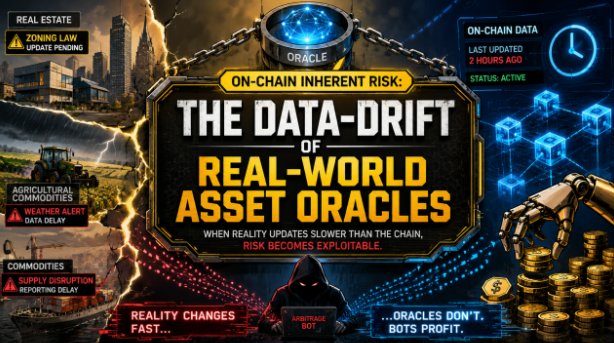
Scenario A: Sudden Zoning Law Changes in Tokenized Real Estate
A municipality rezones a commercial property to residential use. In traditional real estate markets, appraisers and brokers update valuations within a few business days.
The oracle pipeline for a tokenized property runs differently. The government property record must be updated first. Then, a data provider must ingest that record. Then the oracle must aggregate it and publish on-chain. This full cycle can take two to four weeks.
During those two to four weeks, the tokenized property is being used as collateral at its pre-rezoning commercial valuation. Borrowers may have already drawn credit against an asset that is now worth 15 to 40% less. When the oracle corrects, those positions are suddenly under-collateralized.
Scenario B: Weather Shocks in Tokenized Agricultural Assets
A drought or flash flood event strikes a major agricultural region. Within minutes, commodity futures markets on CME or ICE begin repricing the affected crop assets. Within hours, traditional market participants have repositioned.
The USDA or FAO revised crop report arrives 48 to 96 hours later. The tokenized agricultural asset oracle, which depends on these official reports, cannot update before that publication.
In this window, arbitrage bots monitoring both traditional commodity feeds and on-chain oracle values identify the pricing gap. They execute against underpriced or overpriced tokenized ag assets. Retail holders of those assets absorb the repricing loss when the oracle finally catches up and triggers mass liquidations.
Scenario C: Commodity Supply Disruptions
A geopolitical event or major port disruption cuts off a key supply route. Spot commodity prices spike 10 to 25% on traditional markets within hours of the news.
The on-chain tokenized commodity representation still reflects the pre-disruption price. The sub-categories of this risk include transportation bottlenecks, sudden export restrictions from a major producing country, and regional production declines from industrial accidents.
Each of these creates a temporary but exploitable pricing gap between what the blockchain believes and what the market knows.
Why Small Data Errors Compound in DeFi: The Amplification Effect
A 5% oracle error does not create a 5% position error in a leveraged DeFi environment. At 10x leverage, it creates a 50% position error.
The amplification chain works as follows. First, leverage multiplies the initial error. Second, liquidation engines operating on drifted prices either fire false liquidations or miss real ones. Third, automated market makers whose pricing curves assume accurate oracle inputs have their pool ratios skewed. Fourth, lending protocols calculate health factors against wrong collateral values.
In stressed markets, a single oracle correction event can cascade simultaneously through multiple interconnected protocols. The correction that was “only” 8% on the oracle becomes a multi-protocol liquidation wave that moves prices by 25% or more across the ecosystem.
The Arbitrage Opportunity Created by Oracle Latency
How Predatory Bots Detect Oracle Delays
Arbitrage bots running against RWA oracles do not guess. They monitor.
A sophisticated operation runs parallel data pipelines: Bloomberg or Reuters feeds for traditional market prices on one side, and on-chain oracle contract values on the other. When the gap between the two exceeds a profitable threshold after accounting for gas costs, the trade executes automatically.
These systems monitor 50 to 100 asset feeds simultaneously, looking for any oracle lag across any asset class. The detection is not reactive. It is continuous and automated.
The Typical Exploit Timeline
Understanding the sequence helps illustrate why retail investors have no practical defense against this:
- Real-world event occurs. A weather shock, regulatory ruling, or supply disruption happens in the physical world.
- Traditional markets reprice. Commodity futures, REIT indexes, or related financial instruments adjust within minutes.
- Oracle update is delayed. The RWA oracle feed, dependent on official reporting agency publication, cannot update for hours to days.
- Bots identify the discrepancy. The gap between traditional market price and on-chain oracle price triggers the bot’s execution threshold.
- Arbitrage extraction begins. Bots buy underpriced or sell overpriced tokenized assets systematically.
- Oracle corrects. Retail holders absorb the repricing loss. Liquidations fire on positions that were technically healthy during the drift window.
What Is Oracle Extractable Value (OEV) and Why It Is Now a Core RWA Risk
Oracle Extractable Value is one of the most significant and least discussed risks in RWA infrastructure in 2026. It did not appear in most oracle risk frameworks until 2024 and is still absent from the majority of investor due-diligence checklists.
OEV is a subset of MEV (Maximal Extractable Value) created specifically when oracle price updates trigger financial events in DeFi protocols. It emerges most visibly during liquidation events in lending platforms.
Here is the mechanism. When an oracle updates a collateral price downward, it crosses a liquidation threshold for some borrowers. That liquidation represents a guaranteed profitable opportunity: the liquidator repays the borrower’s debt and claims the collateral at a discount (the liquidation bonus). MEV bots compete to capture this by bidding gas to be included first. The protocol and its liquidity providers receive nothing from this premium extraction.
For RWAs, OEV is structurally more severe than in standard DeFi for three reasons:
- Oracle updates for physical assets are less frequent, meaning each correction is a larger price jump, generating a larger OEV event
- Liquidation bonuses for illiquid RWAs must be higher to attract liquidators, creating larger OEV opportunities
- Cross-market intelligence gives bots advance warning from traditional market moves, allowing them to position before the oracle update even occurs
Major protocols like Aave and Compound have each lost over $100 million in cumulative value to MEV and OEV extraction. As the RWA sector scales toward the multi-trillion projections, this number will grow proportionally.
RedStone Atom (launched 2025) is currently the only liquidation-aware oracle specifically designed to capture OEV and redirect it back to protocols rather than to MEV bots. It integrates liquidation logic directly into price feeds and runs atomic liquidation auctions. As of H1 2025, it was live on Compound, Morpho, and Venus.
Real Examples of Oracle-Based Mispricing Events
The most documented oracle exploitation events in DeFi history were primarily manipulation attacks rather than data drift cases. Harvest Finance (2020, $34 million), Cheese Bank (2020), and Mango Markets (2022, $114 million) each involved deliberate price manipulation via flash loans or large trades.
Data drift events are harder to trace precisely because they appear as normal liquidations or repricing events. The protocol functioned correctly given the data it had. The problem was the data itself.
The aggregate $14.6 million in H1 2025 oracle-related losses includes both categories. As RWA adoption grows and physical asset oracle pipelines become more common, the drift-related portion of that figure will likely dominate.
Why Human Investors Cannot Compete With Arbitrage Bots
The structural disadvantage is too large to overcome through vigilance or faster reflexes.
Bots execute in under 10 milliseconds. Human reaction time is 200 to 300 milliseconds at best, and that assumes the human is actively watching the right feed at the exact right moment. Bots watch 24 hours a day, 7 days a week, across all assets simultaneously.
The cross-market intelligence systems these bots run correlate traditional commodity feeds, weather APIs, shipping data, satellite imagery analysis, and on-chain oracle values in parallel. A retail investor checking their portfolio once a day has no mechanism to detect that the asset’s oracle drifted during the previous 48 hours and that bots already extracted the arbitrage value.
When an oracle latency window opens, it is structurally captured by automated systems. Retail investors and the protocol itself absorb the cost.
Measuring Oracle Latency: Which Networks Respond Fastest in 2026?
Why Latency Matters More Than Accuracy Alone for RWAs
An oracle can publish a perfectly accurate value at the moment of publication. If it publishes every 10 minutes, it is still up to 9 minutes and 59 seconds out of date. For a high-volatility event, that gap is the entire arbitrage window.
For real-world assets, latency is the primary vector for data drift. The combination of slow publication frequency and slow underlying source reporting creates a compounding lag that no amount of publication accuracy can fix.
The implication is important: evaluating an oracle purely on “has it ever published wrong data” misses the core risk. The more important question is “how long does it take to publish correct data after the real world changes.”
Methodology for Comparing Oracle Networks
A fair comparison of oracle networks for RWA use cases requires evaluating four distinct latency components:
- Data source acquisition latency: How quickly does the oracle network receive new data from its real-world sources? This is often the dominant latency for physical assets.
- Validation and aggregation time: How long does multi-source verification and aggregation take before a value is ready to publish?
- Update frequency policy: Does the oracle push on a heartbeat schedule, trigger on deviation thresholds, or publish only on demand?
- Blockchain confirmation delay: Network-dependent. Ethereum mainnet averages approximately 12 seconds per block. Solana averages approximately 400 milliseconds. Most L2s land between 1 and 2 seconds.
For RWA protocols deployed on slower chains, the blockchain confirmation delay alone can exceed the oracle’s internal processing time. The chain matters as much as the oracle.
Oracle Network Comparison: Chainlink vs Pyth vs RedStone vs Switchboard (2026)
Critical accuracy note for readers: Chainlink operates two delivery models. Its legacy Price Feeds are push-based. Its newer Data Streams product is pull-based. These are not interchangeable. The original marketing description of Chainlink as purely “push-based” and Pyth as “push-based” (a common error in 2024-era content) is incorrect. The table below reflects verified 2026 specifications.
| Oracle Network | Update Model | Standard Latency | Ultra-Low Latency Option | RWA Strengths | Key Weaknesses |
| Chainlink Price Feeds | Push-based (deviation trigger or heartbeat) | ~10-minute heartbeat or 0.5% deviation trigger | Sub-second via Data Streams (pull) | Largest network; 400+ chains; battle-tested; Proof of Reserve; institutional CCIP | Slower standard feeds; gas costs at high frequency |
| Pyth Core | Pull-based (on-demand) | ~400 ms | 1ms via Pyth Lazer | First-party data from 120+ institutional publishers (Jane Street, Wintermute, CBOE); strong derivatives coverage | Limited physical/RWA-specific asset feeds; chain coverage expanding |
| RedStone | Dual: Push + Pull (on-demand) | 8 to 20 seconds (push); on-demand (pull) | 0.5ms via Bolt | 110+ chains; native RWA/tokenized fund feeds including BlackRock BUIDL; TSSO institutional framework; OEV capture via Atom | Newer; off-chain data availability introduces different trust assumptions |
| Switchboard | Pull-based; permissionless feed creation | ~400 ms average | TEE-secured sub-second | Permissionless feed creation; TEE security; censorship-resistant; Solana-native | Lower TVS and ecosystem adoption vs. top 3; less RWA-specific tooling |
Chainlink Price Feeds use a push model where node operators automatically publish updates when a price deviates by 0.5% or a time-based heartbeat threshold is reached. Chainlink Data Streams is a separate, newer product using a pull model with sub-second latency for high-frequency trading applications.
Pyth Core operates on a pull model where protocols request price data on-demand. Standard feeds update approximately every 400 milliseconds. Pyth Lazer is a separate, complementary product offering updates as fast as 1 millisecond, also supporting 50ms and 200ms stream options. Pyth Lazer targets latency-critical applications like perpetual futures and high-frequency on-chain market makers.
RedStone supports both delivery models. Its pull model allows on-demand pricing for cost efficiency. Its push model targets standard DeFi integrations. The Bolt product delivers ultra-low latency at 0.5ms. The Atom product adds liquidation-aware OEV capture. RedStone currently powers tokenized fund data for BlackRock BUIDL and has the most RWA-specific infrastructure tooling of the four networks.
Switchboard uses Trusted Execution Environments (TEEs) for security, which provides a hardware-secured data processing layer. Unlike the other three, Switchboard allows any developer to create a data feed permissionlessly. This makes it more flexible but is currently less adopted in institutional RWA contexts.
Real-World Reporting Delays vs Oracle Delays: Where the Bottleneck Actually Lives
For most RWA categories, the oracle network is not the bottleneck. The underlying data source is.
Even a 1-millisecond oracle can only publish data as current as its slowest source. Consider the actual reporting cycles for major RWA data categories:
- Municipal property records: Update weeks to months after a physical change occurs. A property sale may not appear in the official registry for 30 to 90 days depending on jurisdiction.
- Commodity reporting agencies (USDA, FAO, IEA): Issue weekly or monthly reports on fixed schedules, regardless of real-world developments between publication dates.
- Agricultural monitoring systems: Satellite crop assessment data has improved significantly but still operates on 3 to 7 day reporting cycles for most producers.
- Carbon credit registries: Verification and issuance cycles can run from 6 to 18 months. Oracle feeds may reflect projected or estimated credit values rather than verified issuances.
Improving oracle network latency from 10 seconds to 10 milliseconds helps when the data source itself updates every 7 days. The critical infrastructure investment for RWAs is not faster oracle networks. It is faster and more continuous real-world data collection.
The Hidden Lag Stack: Six Layers of Cumulative Delay
The total latency from real-world event to on-chain update is the sum of six sequential delays. Most oracle analysis addresses only layers 4 and 5. Layers 1 through 3 dwarf them for physical assets.
Layer 1: Physical Event Delay. The event occurs in the physical world. A flood starts. A zoning ordinance passes. A shipping route closes. The clock starts here.
Layer 2: Data Collection Delay. A monitoring system, agency, inspector, or sensor detects and records the event. For automated financial data, this is milliseconds. For a government agency inspecting property damage, it could be weeks.
Layer 3: Reporting Delay. The data collector publishes updated figures. This is the most variable layer for RWAs. A USDA crop report publishes on its scheduled date regardless of what happened to crops in the meantime.
Layer 4: Oracle Ingestion Delay. The oracle network ingests the newly published data, validates it against multiple sources, aggregates it, and prepares an on-chain update.
Layer 5: Blockchain Confirmation Delay. The oracle’s update transaction is broadcast and confirmed on-chain. Chain-dependent: approximately 12 seconds on Ethereum mainnet, 400 milliseconds on Solana, 1 to 2 seconds on most L2s.
Layer 6: OEV Extraction Window. This layer was not recognized in most oracle frameworks before 2025. After an oracle update is pending but before it is finalized, MEV bots monitoring the mempool can identify the incoming price change and front-run or back-run the resulting liquidation events. This is Oracle Extractable Value in action. For large oracle corrections after extended drift periods, this window represents the largest single loss mechanism for RWA protocols.
Quantifying the Financial Fallout of Data Drift
Overvalued Collateral Risk
When an oracle lags behind a real-world value decrease, on-chain collateral appears worth more than the asset currently justifies. Borrowers draw credit against this inflated figure. The protocol carries the exposure.
When the oracle eventually corrects, two things happen. The collateral coverage ratio drops immediately. Positions that were technically healthy during the drift period are suddenly under-collateralized. Liquidation engines fire. And because the correction is typically a larger-than-normal price jump (catching up for missed drift), the liquidation wave is correspondingly larger than it would have been with continuous updates.
Underpriced Asset Risk
The reverse drift scenario is less dramatic but creates a systematic wealth transfer. When an oracle lags behind a real-world value increase, tokenized assets are temporarily underpriced on-chain.
Buyers with access to real-world data can acquire underpriced tokens at a discount. Sellers who rely on the oracle price are transacting below fair value. This is not a manipulation exploit. The oracle is simply late. But the economic outcome is identical: value flows from oracle-dependent participants to information-advantaged participants.
Liquidation Cascades
A single large oracle correction after an extended drift period can trigger simultaneous liquidations across every protocol holding that asset as collateral.
For liquid crypto assets, a liquidation cascade eventually finds a price floor because there are buyers at every level. For illiquid tokenized physical assets, the emergency liquidation of positions may find no buyers at any reasonable price. The protocol must absorb bad debt, and the loss is distributed across liquidity providers or token holders.
Market Confidence Erosion
Retail investors who experience liquidations they cannot explain will not stay in the protocol. Institutions experiencing audit trails with unexplained repricing events cannot justify continued participation to their compliance teams.
Data drift events do not look like attacks. They look like the protocol working normally. That makes them more corrosive to confidence, not less. At least an obvious hack has a clear explanation.
Systemic Risk Across the RWA Sector
The interconnected structure of 2026 DeFi means oracle data drift at the base layer amplifies upward through every protocol that depends on it.
Consider the chain: a tokenized Treasury fund like BlackRock BUIDL provides collateral for a stablecoin like Ethena’s USDtb, which is then used as collateral in a lending protocol, which issues loans that are pooled into a yield product. A mispricing at the BUIDL oracle layer propagates upward through every layer of this stack.
If the tokenized RWA sector reaches Citi’s $4 to 5 trillion estimate by 2030, a 0.1% oracle drift event represents $4 to 5 billion in misallocated capital across the system.
Why Current Oracle Architectures Struggle With RWAs
Designed for Financial Markets, Not Physical Assets
The major oracle networks were architected to serve crypto price feeds. Their foundational assumption is that the underlying data is continuous, liquid, globally traded, and available from multiple competing sources at all times.
Physical assets have none of these properties. A tokenized commercial property in Warsaw is appraised quarterly by one firm. A tokenized crop yield in Nebraska is assessed by a government agency on a monthly schedule. An oracle architecture optimized for ETH/USD price feeds is fundamentally mismatched to this problem.
The Challenge of Non-Continuous Data Sources
Financial price feeds update tick-by-tick, around the clock. The oracle’s job is aggregation and publication of continuously generated data.
For RWAs, the oracle’s job is fundamentally different: waiting for infrequent, scheduled data publications and then publishing them on-chain. The oracle cannot generate data that the source has not yet produced. No amount of oracle infrastructure investment solves a problem that lives in the reporting schedule of a government agency.
Regulatory and Geographic Data Fragmentation
A tokenized real estate portfolio spanning 10 jurisdictions draws from 10 different municipal record systems with 10 different update schedules, 10 different data formats, and 10 different standards for what constitutes an “official” record.
There is no standardized global reporting format for physical asset data. Cross-border regulatory differences mean data that satisfies compliance standards in one jurisdiction may be rejected in another. Oracle networks serving global RWA protocols must manage this fragmentation manually, which adds both latency and error risk.
Verification Bottlenecks
RWA data often requires physical verification that cannot be automated at oracle speeds. A property must be inspected. A vault must be audited. A crop must be assessed by a qualified agronomist.
Protocols face a binary choice with no clean resolution: accept unverified data quickly (accepting accuracy risk) or wait for verified data slowly (accepting latency risk and data drift). Most current RWA protocols choose the latter, which is why oracle latency for physical assets remains measured in days rather than seconds.
OEV: Oracle Extractable Value and Why It Changes the RWA Risk Calculation
What OEV Is and Why It Is Different From General MEV
MEV covers all forms of value extraction through transaction ordering within blocks. OEV is the specific subset that arises from oracle price update events.
The mechanism is precise: an oracle update causes a DeFi protocol to cross a threshold. In lending markets, this threshold is typically a liquidation trigger. The moment the update is pending, a guaranteed profitable opportunity exists. Bots compete for it by bidding gas. The winner captures the liquidation bonus. The protocol receives nothing from this extraction.
OEV is not a bug in MEV or in oracle design. It is a structural property of threshold-based protocols that depend on external data. It exists in every major lending protocol. The question is who captures it.
How OEV Amplifies Data Drift Damage
Without OEV capture mechanisms, the damage from data drift is multiplied. Here is why.
Extended data drift creates a larger-than-normal price correction when the oracle finally updates. A larger correction triggers more simultaneous liquidations. More simultaneous liquidations represent a larger aggregate OEV event. More MEV bots compete for it, driving gas wars. The protocol and its users absorb both the repricing loss and the friction cost of the bot competition.
In a protocol with robust OEV capture, some of this value would return to the protocol treasury or be used to reduce liquidation penalties for borrowers. Without capture, it exits the ecosystem entirely.
Current OEV Solutions in the 2026 Oracle Landscape
The OEV solution space is still early but moving quickly:
RedStone Atom integrates liquidation logic directly into oracle price feeds. Instead of publishing a price update and waiting for bots to react, Atom bundles the oracle update with the liquidation execution in a single atomic transaction. The OEV is captured through an auction and redistributed to the protocol. It is currently live on Compound, Morpho, Venus, and Upshift, with expansion to Berachain, HyperEVM, Base, and BNB Chain underway.
API3’s OEV Network allows protocols to auction the right to update oracle prices. The auction winner pays to trigger the update, and those proceeds go to the protocol’s dApp. This flips OEV from a cost to a revenue stream.
Pyth Lazer’s 1ms updates address OEV differently: by minimizing the gap between traditional market prices and on-chain oracle values, the profitable window for OEV extraction shrinks. Less drift means smaller corrections. Smaller corrections mean smaller OEV events.
The practical implication for RWA investors and protocol developers is that OEV capture is now a measurable feature difference between oracle providers. A protocol choosing an oracle without OEV capture is accepting a structural ongoing cost that will scale with the protocol’s TVL.
Emerging Solutions to the Data-Drift Problem
Real-Time Sensor Networks and IoT Feeds
The most direct solution to data drift in physical asset oracles is reducing the gap between physical events and digital records. IoT sensor networks are the primary tool being deployed for this.
Practical applications include: soil moisture and temperature sensors for agricultural asset monitoring, GPS and weight sensors on commodity shipments for real-time supply chain data, building occupancy and condition sensors for tokenized real estate, and satellite imaging for continuous crop health assessment.
The challenge is adoption at scale. Deploying a sensor network across a diversified agricultural portfolio spanning multiple countries requires significant capital and operational coordination. The data authenticity problem also remains: a sensor reading is only as trustworthy as the physical security of the sensor itself.
AI-Powered Anomaly Detection
AI models trained on historical asset data can identify when an on-chain oracle value has diverged from expected conditions, even before official data publications arrive.
A predictive model monitoring weather data, shipping route disruptions, and commodity futures can flag that a tokenized crop asset in a drought-affected region likely requires urgent oracle review before the USDA publishes its next weekly report. This does not solve the underlying data gap, but it enables protocols to take defensive action (pausing collateral draws, requiring additional margin) while the official data catches up.
Several top RWA tokenization platforms in 2026 are using AI valuation engines for continuous NAV monitoring, particularly for private credit and real estate portfolios.
Multi-Layer Oracle Validation
Cross-referencing multiple independent oracle sources for the same asset adds a layer of drift detection. If two independent oracle feeds for the same asset diverge beyond a threshold, the protocol can automatically pause activity on that asset and trigger an emergency verification request.
This approach adds latency but provides a meaningful safety mechanism against undetected drift. It is particularly appropriate for high-value, low-liquidity RWA collateral positions where the cost of a bad liquidation significantly exceeds the cost of a brief pause in protocol activity.
Dynamic Update Frequencies
Context-aware update triggers allow protocols to increase oracle update frequency when market conditions warrant it, rather than running all assets at the same cadence regardless of real-world conditions.
In stable conditions, a weekly real estate oracle update may be adequate. When a hurricane track is announced, or a regulatory hearing is scheduled, the system can automatically shift to hourly or even continuous monitoring for affected asset categories.
RedStone and Chainlink Data Streams both support configurable deviation-threshold triggers that can be tuned per asset class. This architecture significantly reduces the cost of high-frequency updates for normally stable assets while ensuring rapid response when it matters.
Hybrid Oracle Architectures
No single approach solves all the layers of the hidden lag stack. The most robust RWA oracle implementations in 2026 combine multiple methods.
Automated feeds handle continuous monitoring and standard update schedules. Human-verified checkpoint audits confirm values at defined intervals. ZK proofs (zero-knowledge proofs) allow complex off-chain data processing to be verified on-chain without revealing underlying raw data. TEE-based oracle nodes provide hardware-secured data processing for the most sensitive data streams.
The architecture that minimizes data drift for physical assets looks fundamentally different from the architecture optimized for financial price feeds. RWA protocols that copy their oracle setup directly from DeFi-native protocols without adaptation are accepting a structural mismatch.
What Investors Should Evaluate Before Buying Tokenized RWAs
Oracle Provider Transparency
The baseline due-diligence question is whether the oracle infrastructure is publicly verifiable. A protocol that cannot answer “which oracle contract address provides our pricing data” is not ready for institutional capital.
Specific questions to ask:
- Which oracle network is used? (Chainlink, Pyth, RedStone, custom, or a combination?)
- Is the oracle contract address published and independently verifiable on-chain?
- Is the oracle decentralized with multiple independent node operators, or does it rely on a single provider?
- Is the aggregation methodology published, or is pricing treated as a black box?
Red flag: “We use a proprietary data feed” with no public contract address and no explanation of the aggregation methodology.
Update Frequency Policies
Matching oracle update frequency to the actual volatility profile of the underlying asset is the most commonly overlooked aspect of RWA oracle due diligence.
Questions to ask:
- How often is the asset revalued? Is this frequency appropriate for the asset’s historical volatility?
- What triggers an off-cycle update? Is there a deviation threshold, or does the protocol only update on a fixed schedule?
- If a major real-world event occurs between scheduled updates, what is the mechanism for requesting an emergency update?
A quarterly-updated real estate oracle is fundamentally unsuitable for a leveraged DeFi position. If the update frequency does not match the risk profile, the mismatch itself is the risk.
Data Source Diversity
A single oracle with multiple independent sources is still one oracle. True redundancy requires independent verification pipelines.
Questions to ask:
- How many independent data sources feed the oracle, and from how many different institutions?
- Are the sources geographically diverse, or concentrated in a single jurisdiction with a single reporting authority?
- Does the protocol have access to real-time IoT or sensor data for physical assets, or does it rely entirely on periodic government reports?
- What happens if the primary data source fails or is delayed? Is there an automatic fallback?
Emergency Update Mechanisms
The most revealing oracle due-diligence question is how the protocol handles the moment when a major real-world event occurs that has not yet been reflected in the scheduled data feed.
Questions to ask:
- Does the protocol have a circuit breaker that pauses activity if oracle data appears stale or drifted beyond a threshold?
- Is there a governance mechanism to trigger emergency oracle updates when a verifiable real-world event has occurred?
- What is the historical response time? Has the protocol actually used its emergency mechanisms, or are they theoretical?
OEV and Liquidation Design
This is the newest category in RWA oracle due diligence and the most commonly absent from investor checklists as of mid-2026.
Questions to ask:
- Does the protocol use an OEV-capture mechanism (RedStone Atom, API3 OEV Network, or equivalent)?
- What is the liquidation bonus structure? High bonuses attract more MEV bot competition and represent a larger ongoing cost to protocol participants.
- Has the protocol been audited specifically for oracle latency risk, separate from oracle manipulation risk? These require different testing methodologies.
Protocols with OEV capture are structurally more capital-efficient. They return value that would otherwise exit the ecosystem back to the protocol or its users. As the RWA sector grows, the cumulative difference between OEV-capturing and non-capturing protocols will become significant.
Historical Latency Performance
Past performance is not a guarantee. But a protocol that cannot provide historical oracle latency data for its asset class should not be trusted with significant capital.
Questions to ask:
- Has the oracle provider published historical latency data specifically for this asset category (not just financial price feeds)?
- Are there any past incidents where oracle drift caused protocol losses or unexpected liquidations? How were they handled?
- Does the reported oracle latency match the actual volatility of the underlying asset? A 7-day oracle update cycle for an asset that can move 20% in a week is a known risk, not an unknown one.
The Future of RWA Tokenization Depends on Solving Data Drift
Why Oracle Accuracy Alone Is Not Enough
Accuracy at publication time is necessary but not sufficient. An oracle that publishes a perfectly correct value once a week for a physical asset with daily price movements is not accurate. It is just wrong on a schedule.
The real-world reporting infrastructure is the binding constraint for RWA tokenization at scale. Even a 0.5-millisecond oracle network cannot solve a problem that originates in a government agency’s monthly publication cycle. The industry needs investment in data collection infrastructure (IoT, satellite monitoring, AI-assisted continuous assessment) at the same priority level as investment in oracle network infrastructure.
Latency Is Becoming a Competitive Advantage and a Protocol Moat
In 2026, oracle providers that demonstrably deliver lower latency for specific RWA asset categories are commanding premium protocol relationships and integration fees.
RedStone’s TSSO framework targets institutional RWA issuers with verified, auditable data pipelines. Pyth Lazer’s 1ms feeds target the high-frequency end of the spectrum. Chainlink’s institutional Data Streams and CCIP target the cross-chain settlement and compliance layer.
Protocols that select their oracle provider based on actual asset-specific latency requirements rather than name recognition will have structurally better risk profiles. That difference will compound over time as the sector grows.
The Next Battlefield: OEV Redistribution
OEV is currently a hidden tax on every RWA protocol that depends on threshold-based liquidations. As the sector scales, this tax reaches numbers that institutional investors will not accept.
At $1 trillion in RWA TVL, even a conservative 0.1% OEV extraction rate represents $1 billion per year leaving the ecosystem to MEV bots. The oracle providers and protocols that standardize OEV capture will capture a significant share of institutional allocation preference.
Within 24 months, OEV capture will likely be a standard line item in institutional RWA due-diligence frameworks, alongside oracle provider identity and update frequency.
Can RWAs Reach Institutional Scale Without Real-Time Data?
The BCG $16 trillion and Citi $4 to 5 trillion projections for tokenized RWAs are conditional, not guaranteed. The condition is that the infrastructure matches the ambition.
Treasury tokenization (T-bills, money market funds) can reach institutional scale with current oracle infrastructure. The underlying data is already continuous, globally priced, and reported in near-real time.
Real estate, agriculture, and carbon credit tokenization face a different ceiling. Until the underlying data reporting infrastructure provides continuous, verifiable, auditable updates at a frequency that matches asset volatility, those categories will remain too risky for large institutional allocations. The blockchain is ready. The data is not.
Conclusion
The data-drift threat to RWA tokenization is not a hacking risk or a manipulation risk. It is the structural consequence of connecting a digital system that operates at millisecond speed to a physical world that reports on weekly and monthly schedules.
Oracle latency has become a genuine competitive differentiator. The networks that built for financial price feeds are adapting. The protocols that choose their oracle infrastructure based on their specific asset class and update frequency requirements will carry structurally lower risk than those that treat oracle selection as an afterthought.
OEV completes the picture. Bots do not just exploit slow oracles passively. They systematically extract liquidation value from every oracle update event in every protocol that has not implemented capture mechanisms. As RWA TVL grows, this extraction scales with it.
The success of tokenized real-world assets may ultimately have less to do with the blockchain infrastructure underneath and more to do with a simple question: how quickly, how verifiably, and how continuously does reality reach the chain? For more information visit, Cryptowealthnet.
Last updated: June 2026. Oracle specifications verified against official documentation at chain.link, pyth.network, docs.redstone.finance, and rwa.io. This article is for informational purposes only and does not constitute investment advice.