


Weak mobile signals seem to be reserved for when you need your phone to work. Maybe it’s a crowded stadium just before a video upload or deep inside a hospital where calls are dropping at the worst possible moment. In a world where everyone is expected to be always connected, everywhere, poor signal coverage is oddly obsolete. But it remains a real problem in large buildings, underground spaces, airports, campuses and densely packed urban areas.
That’s where Distributed Antenna Systems, more commonly known as DAS, come in. Most people never see these systems hidden behind ceilings, walls and infrastructure panels. But quietly, they have become among the most important technologies behind modern wireless communications. The DAS market is gaining real traction across several industries with the growth of 5G and the continued explosion of mobile data usage.
The interesting thing about this market is the intersection of convenience, infrastructure and necessity. We often discuss exciting tech such as AI or smart gadgets, but none of those experiences function seamlessly without reliable connectivity below them. DAS may not be the glitziest part of telecom infrastructure, but it is fast becoming one of the most essential.
Reliable indoor connectivity is more important than ever
People spend most of their time indoors, but mobile networks have traditionally focused more on outdoor tower coverage. That mismatch caused a surprisingly common problem. Thick walls, steel structures, heavy glass architecture or underground environments attenuate signals greatly when penetrating.
Think of sports stadiums, office buildings, transportation centers, or shopping malls. These spaces often have tens of thousands of people using mobile devices concurrently. Networks overload quickly without the right infrastructure. Almost immediately, users get frustrated with slow internet speeds and drop calls.
This change in consumer behavior has forced businesses and property owners to rethink connectivity. Dependable indoor coverage is no longer a luxury item. It is now part of the customer experience. Hotels want guests to stream without stuttering. “Medical staff need reliable communication systems in hospitals. Corporate offices need continuous video conferencing and cloud access.
A few years ago, poor indoor signals were just a fact of life. Today, people want to be seamlessly connected everywhere they go. And that expectation is fueling demand for DAS installations at an extraordinary rate.
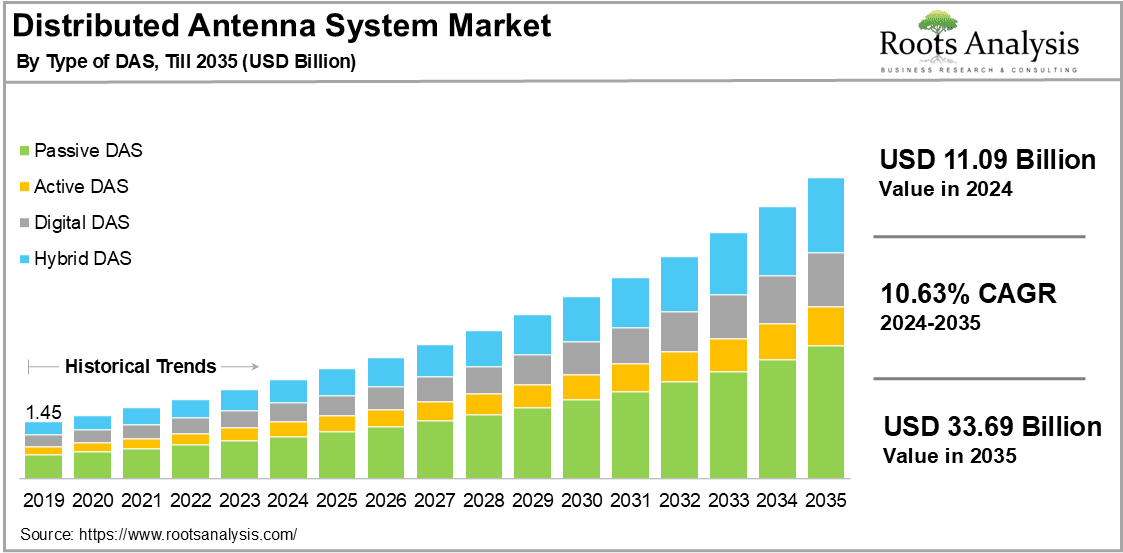
I recently came across Roots Analysis, and they mention that “The distributed antenna system market size is projected to grow from $11.09 billion in 2024 to $33.69 billion by the year 2035, representing a CAGR of 10.63%, during the forecast period 2024-2035. These numbers underline just how essential wireless infrastructure is to everyday life.
The Truth About DAS
Distributed Antenna Systems sound more complex than they actually are for a lot of people. Essentially, DAS enhances wireless coverage by relaying cellular or radio signals from multiple antennas placed throughout a building or location.
DAS spreads the signal over a location, rather than relying on one strong antenna. This is more robust and consistent coverage. It’s like trying to light up a huge room with one flashlight compared to using several smaller lights spread throughout the room. The second choice naturally leads to better coverage and fewer dark spots.
There are two main types of DAS systems, generally speaking: active and passive. Passive DAS uses coaxial cables and components to distribute signals, whereas active DAS uses fiber optics and powered equipment for larger, more complex environments.
Active systems are becoming more and more popular in large venues because they can accommodate higher data capacity and better scalability. Active DAS are often required in stadiums, airports, convention centers due to the large number of connected users moving through these spaces.
An interesting thing about DAS is that the average person can’t see it. If a system works, it doesn’t get noticed. People just assume their phones are working properly. There’s something about that quiet reliability that makes DAS infrastructure so valuable.
5G’s Role in Accelerating the DAS Market
You can’t talk about the DAS market without talking about 5G. One of the biggest drivers for DAS adoption is the roll-out of 5G networks. 5G promises faster speeds, lower latency and the ability to connect huge numbers of devices. But there is a hitch. Many 5G networks operate on higher-frequency signals that struggle to travel long distances or go through buildings. This means indoor coverage solutions are becoming more important.
This is where DAS systems can help in a practical way. They help extend and improve 5G service indoors, so users can experience the speed and reliability that telecom providers promise. This is especially true for large venues. Think about a sports stadium packed with tens of thousands of fans, all posting videos, streaming, and posting on social media simultaneously. Without a robust DAS infrastructure, the network will soon be overwhelmed by traffic.
The growth of the market is also aided by smart buildings. Increasingly, modern offices rely on connected sensors, automation systems, IoT devices and cloud-based operations. These environments are based on wireless communication, and it should be stable.
Some telecom experts have even called the DAS the “hidden engine” behind the indoor 5G experience. That description sounds pretty accurate because while consumers are focused on smartphone features, infrastructure providers are focused on making those experiences possible.
Industries Leading DAS Adoption
The DAS market is growing in a number of sectors with their own connectivity requirements. Healthcare is a big area of application. Hospitals need to communicate continuously, not just for administrative tasks, but also for patient monitoring systems, emergency response coordination, and connected medical devices. Weak signals inside healthcare facilities can pose a serious operational risk.
Transportation hubs, another important segment. Every day, airports, subways and train stations generate a ton of mobile traffic. Travelers rely on dependable connectivity to navigate, communicate and entertain themselves en route.
Increasingly, commercial real estate developers are incorporating DAS in their designs from the start rather than as an afterthought. Great indoor connectivity is required in modern workspace infrastructure for today’s premium office tenants.
Educational campuses are also making large investments in DAS solutions. Universities support thousands of students simultaneously using connected devices for online learning, communication and streaming services.
As industrial automation increases, manufacturing facilities are getting into the act. Smart factories comprise connected machinery, sensors and real time analytics systems that require strong wireless performance.
What is clear across these industries is that connectivity is becoming inherently linked to operational efficiency. It’s no longer about convenience of users only. The reliability of wireless communications has a direct impact on productivity and safety in many environments.
Challenges in the DAS Market
However, despite the strong growth outlook, the DAS market still faces several challenges that slow adoption in some regions and industries. Cost is still one of the biggest hurdles. Deploying DAS infrastructure in large facilities can be expensive, particularly in older buildings that were never designed with modern connectivity systems in mind. Retrofitting infrastructure often involves complex construction work, cabling and coordination with network operators.
There is also the matter of technical complexity. Proper planning of the building architecture, user density and behavior of the signals shall be considered for effective DAS solution. A badly designed system can cause interference problems instead of fixing connectivity problems.
Regulatory requirements add another level of difficulty. Building codes, safety standards and telecom regulations vary across regions, adding complexity to deployments of multinational projects.
Coordination between property owners and telecom carriers can be frustrating, too. Typically, there are several stakeholders involved and alignment of priorities is not always a clear path. Cybersecurity concerns are also starting to get more attention. As buildings become increasingly connected, it is important to protect the communication infrastructure from vulnerabilities.
Despite these challenges, the overall market direction continues to be strongly positive as the demand for reliable connectivity continues to grow faster than the hurdles to deployment.
Deeply Connected Looks of the DAS Future
The future of the Distributed Antenna System market appears to be tied to the growth of social trends. We are heading towards a world where practically everything depends on continuous wireless communication. Stronger network infrastructure is needed for smart cities, autonomous systems, connected healthcare, hybrid workspaces and immersive digital experiences.
In the future, DAS technology will likely be increasingly incorporated in building design and urban planning. Future infrastructure projects could start to treat indoor wireless coverage the same way they do electricity or water systems today. Essential. Expected. Impossible to overlook.
There is also growing interest in integrating DAS with private wireless networks and edge computing systems. In industries where low latency and data security are critical, businesses want more control over connectivity.
One thing is certain. We know that consumers don’t think much about the infrastructure behind their mobile experience until something goes wrong. But behind every smooth video call, mobile payment or live streamed event, there is an invisible network of technologies that make it possible. DAS has quietly become part of that invisible infrastructure.
Conclusion
The world is becoming more and more dependent on good indoor connectivity and the market for Distributed Antenna Systems is expanding. Whether it’s hospitals or airports, office buildings or stadiums, organizations are waking up to the fact that they can no longer live with poor wireless coverage in an increasingly connected world.
Demand is being driven even higher by the rise of 5G, smart buildings and data-hungry applications. Although the costs of installation and technical challenges still exist, the long-term outlook is still strong with industries still investing in better communication infrastructure.
What makes DAS particularly interesting is that it tackles a problem that most people face daily but rarely consider in detail. We just want our devices to work when we work. That expectation relies on a growing ecosystem of infrastructure that quietly keeps the modern digital world connected.