

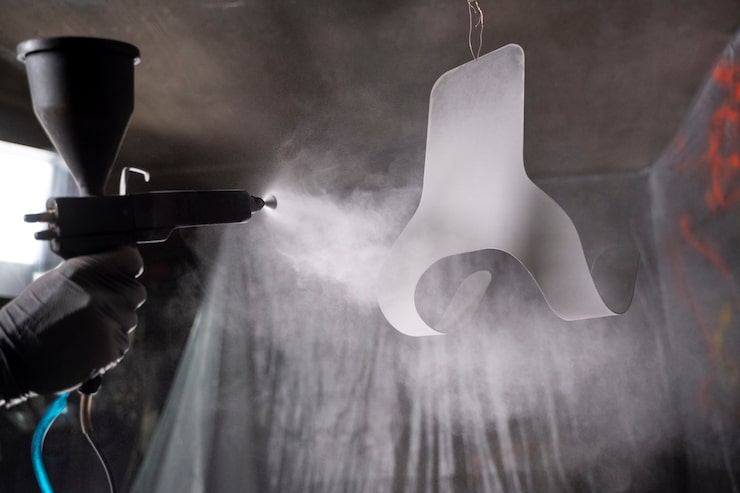

Efficiency in powder coating often breaks down at a point many operations overlook: the physical shape of the part itself. Geometry influences how powder travels, where it settles, and where it refuses to stick. Matching powder coating equipment to part geometry is less about preference and more about physics, airflow, and electrostatic behavior working together.
Understanding Why Geometry Dictates Equipment Choice
Part geometry determines how powder behaves from the moment it leaves the gun. Flat panels accept powder easily, while deep channels, tight corners, and recessed features resist uniform coverage. Equipment that works perfectly for one shape may fail completely on another. This is why powder coating systems are never truly one-size-fits-all. Gun voltage range, airflow settings, booth size, and part presentation must align with the shape being coated. Evaluating geometry early prevents wasted material, rework, and inconsistent finishes that no amount of operator skill can fully overcome.
How Shape and Size Affect Powder Gun Reach
Gun reach is not just about distance; it is about line of sight and electrostatic pull. Long or boxed-in parts create Faraday cage effects that repel powder from corners and recesses. Standard guns may not penetrate these areas effectively, even at higher voltage settings.
Larger parts also change how powder clouds behave in the booth. As size increases, powder dispersion becomes harder to control, requiring guns with adjustable patterns and consistent output. Selecting powder coating equipment for sale without accounting for reach often leads to uneven film builds and missed surfaces.
What Happens When Equipment Doesn’t Fit the Part
Mismatch shows up quickly on the finished product. Thin spots appear in corners, while heavy buildup forms on exposed edges. Operators compensate by slowing down or overapplying powder, which increases cycle time and material waste.
Over time, this mismatch stresses powder coating equipment as well. Guns clog more frequently, reclaim systems struggle with excess overspray, and booths become harder to keep clean. These problems are symptoms of geometry and equipment working against each other rather than in sync.
Signs Your Current Setup Isn’t Working Right
Inconsistent thickness across similar parts is a strong warning sign. If identical pieces show variation from batch to batch, equipment limitations may be the cause. Another indicator is frequent manual touch-up after curing, which signals poor initial coverage.
High powder consumption with low transfer efficiency is also telling. When powder coating equipment packages are not suited to the parts being coated, more material ends up on booth walls than on the product. Monitoring reclaim ratios often reveals this imbalance before defects become obvious.
The Role of Booth and Gun Positioning in Coverage
Booth design plays a major role in how geometry is coated. Airflow direction, exhaust placement, and booth dimensions influence how powder moves around complex shapes. Poor airflow can pull powder away from recessed areas before it has a chance to adhere.
Gun positioning matters just as much. Fixed gun setups may work for simple shapes but struggle with varied part profiles. Adjustable mounts and multi-angle gun placement allow powder coating systems to adapt to geometry rather than forcing parts to fit the equipment.
How Small Details Change Your Equipment Needs
Minor design features can drastically change coating behavior. Threaded holes, slots, weld seams, and internal cavities each affect how powder deposits. Equipment that handles smooth surfaces may fail to coat these details evenly.
These small features often require lower voltage capability, specialized nozzles, or pulse control to overcome repelling forces. Ignoring these needs when selecting powder coating equipment leads to repeated adjustments and inconsistent results that slow production.
Why Rotation and Fixturing Matter for Consistent Coats
Static parts limit how powder reaches all surfaces. Rotation introduces new angles, reducing shadowing and improving wrap around edges. Even slow rotation can dramatically improve coverage on tubular or multi-sided parts.
Fixturing also affects grounding quality, which directly impacts electrostatic attraction. Poor grounding weakens powder adhesion, especially on complex shapes. Well-designed fixtures paired with the right powder coating systems stabilize both part position and electrical performance.
What Factors Drive Better Powder Flow Control
Powder flow must match the resistance created by part geometry. High flow overwhelms tight spaces, while low flow may never reach deep recesses. Control comes from balancing air pressure, powder output, and gun settings.
Advanced control options allow operators to fine-tune delivery for different shapes without changing hardware. Choosing powder coating equipment packages with flexible flow control prevents overcorrection and keeps finishes consistent across varied geometries.
How Right-sized Tools Cut Overspray and Thin Spots
Equipment sized to the part reduces wasted motion and material. Smaller guns with precise patterns excel on intricate parts, while larger guns suit broad surfaces. Matching tool scale to geometry improves transfer efficiency and film uniformity.
Overspray drops when powder is directed where it is needed instead of flooding the booth. Thin spots disappear when guns can reach and coat difficult areas without excessive voltage. Right-sized powder coating equipment supports both quality and cost control.
Reliant Finishing Systems works with manufacturers to align part geometry with properly configured coating equipment and system layouts. Their team focuses on practical, geometry-driven solutions that improve coverage, reduce material waste, and support consistent finishes. This approach helps operations achieve dependable results without relying on trial-and-error adjustments.